


Perhaps you have thought about paying someone “under the table”. It will be great, I will save on taxes, avoid paperwork, or help someone out—this article is for you.
What many may be unaware of is that this is a trap that can hurt even those with the best of intentions. In the end, many end up in financial and legal turmoil. The dangers are real, the consequences are severe, and one misstep can destroy years of hard work.
Let me walk you through a real-world scenario, explain why this happens, and show you what you need to do to avoid it.
From Friendly Favor to Financial Catastrophe
Meet Mark, a successful small business owner who hired a man named David to help around his home, cutting grass, organizing the garage, and running errands. Mark paid David in cash and sometimes by writing checks made out to "cash," which David cashed at Mark’s bank.
Over time, Mark began asking David to help with small tasks for his business—dropping off packages, picking up supplies, and delivering products. One day, while David was running an errand for the business, he was involved in a serious car accident.
David suffered multiple injuries, underwent surgery, and was unable to work for several years. His medical bills quickly soared to several hundred thousand dollars.
That’s when everything unraveled.
What Went Wrong?
At the hospital, David was asked where he was going when the accident occurred. Without thinking, David explained that he was delivering items for Mark’s business at the time of the crash.
David had no health insurance. The Investigators uncovered that checks were written to cash by both Mark personally and his business account.
Mark claimed that David was a “contractor,” but no 1099 had ever been filed.
Neither Mark’s homeowners insurance nor his business insurance would cover the injury—they excluded coverage for undisclosed, off-the-books workers.
Then, the state workers’ compensation board opened up an investigation. The Investigators uncovered that checks were written to cash by both Mark personally and his business account. The State stepped in to cover David’s medical bills, then sued Mark for reimbursement.
In the end, Mark was:
The State recovered $200,000.00 in medical expenses.
David sued, and Mark settled for $150,000.
Audited by the IRS for unpaid employment taxes $7,500.00.
Penalized by the State for failure to carry workers’ compensation insurance for $50,000.00.
Ordered to pay interest, back taxes, and penalties over $20,000.00
What started as a casual, under-the-table arrangement turned into a years-long financial disaster.
The Legal Realities of Under-the-Table Employment
Mark's story is not unique. Every year, thousands of individuals and business owners make similar mistakes. Here’s why under-the-table arrangements are illegal and dangerous:
It’s Tax Evasion
Paying workers off the books avoids employment taxes—but it’s illegal. The IRS and state labor departments can:
Reclassify the worker as an employee
Demand back taxes for income, Social Security, Medicare, and unemployment insurance
Impose steep penalties and interest
"Cash" and "To-Cash" Checks Don’t Hide You
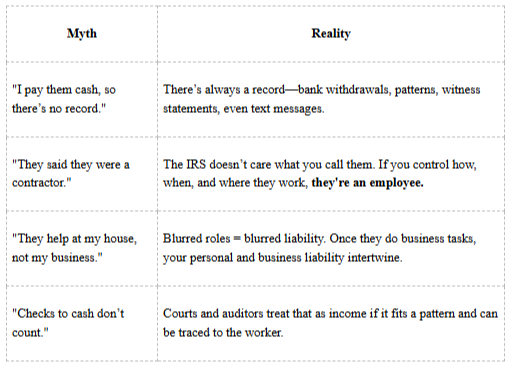
Writing checks to “cash” does not shield you. If there’s a pattern of payments, and the worker can show they received those funds, tax authorities will treat it as proof of employment and may view it as a deliberate attempt to conceal the relationship.
Insurance Won’t Cover You
Whether it’s:
Homeowners' insurance (for domestic workers),
Auto insurance (if the worker is driving on the job),
Or business liability coverage,
None of these policies will honor claims for undocumented or undisclosed workers.
You’re Liable for Injuries
If a worker gets injured and there’s no workers’ comp insurance, the State may step in temporarily, but they will seek full reimbursement from you, often with penalties.
And in personal injury lawsuits, courts tend to favor the injured party, especially if the defendant failed to follow employment laws.
Common Myths That Get People in Trouble
What You Should Do Instead
To avoid financial ruin, do things the right way:
For Household Help:
Use services like a payroll service to manage domestic employee taxes.
File Schedule H with your tax return.
Pay legally and provide workers’ comp if required by your State.
For Business Help:
Classify workers properly using IRS guidelines.
Issue W-2s for employees and 1099s for true contractors.
Use a payroll service to handle deductions and tax filings.
Maintain appropriate business insurance and workers’ comp coverage.
Final Thoughts
The truth is simple: Hiring someone under the table is never worth the risk.
It may save you a few dollars today, but it could cost you your savings, your business, or even your home tomorrow. Our job is to help clients build and protect wealth. That starts with smart, legal, and ethical financial decisions.
If you're paying someone off the books—or thinking about it—stop now and get advice. Protect yourself, your finances, and your future.
Need help sorting out employment compliance, taxes, or risk management?
Schedule a consultation with us today to review your situation and ensure you’re covered legally and financially.
The individuals, scenarios, and names mentioned in this article may be fictional or altered to illustrate financial concepts and to protect client confidentiality. This material is for informational and educational purposes only. It is not intended as legal, tax, or accounting advice, and should not be relied upon as such. HT Partners LLC is not licensed to provide legal, tax, or accounting advice. Clients should consult their attorney, tax professional, or accountant for advice specific to their individual circumstances.